
What Is a Pun? | Definition, Types & Examples
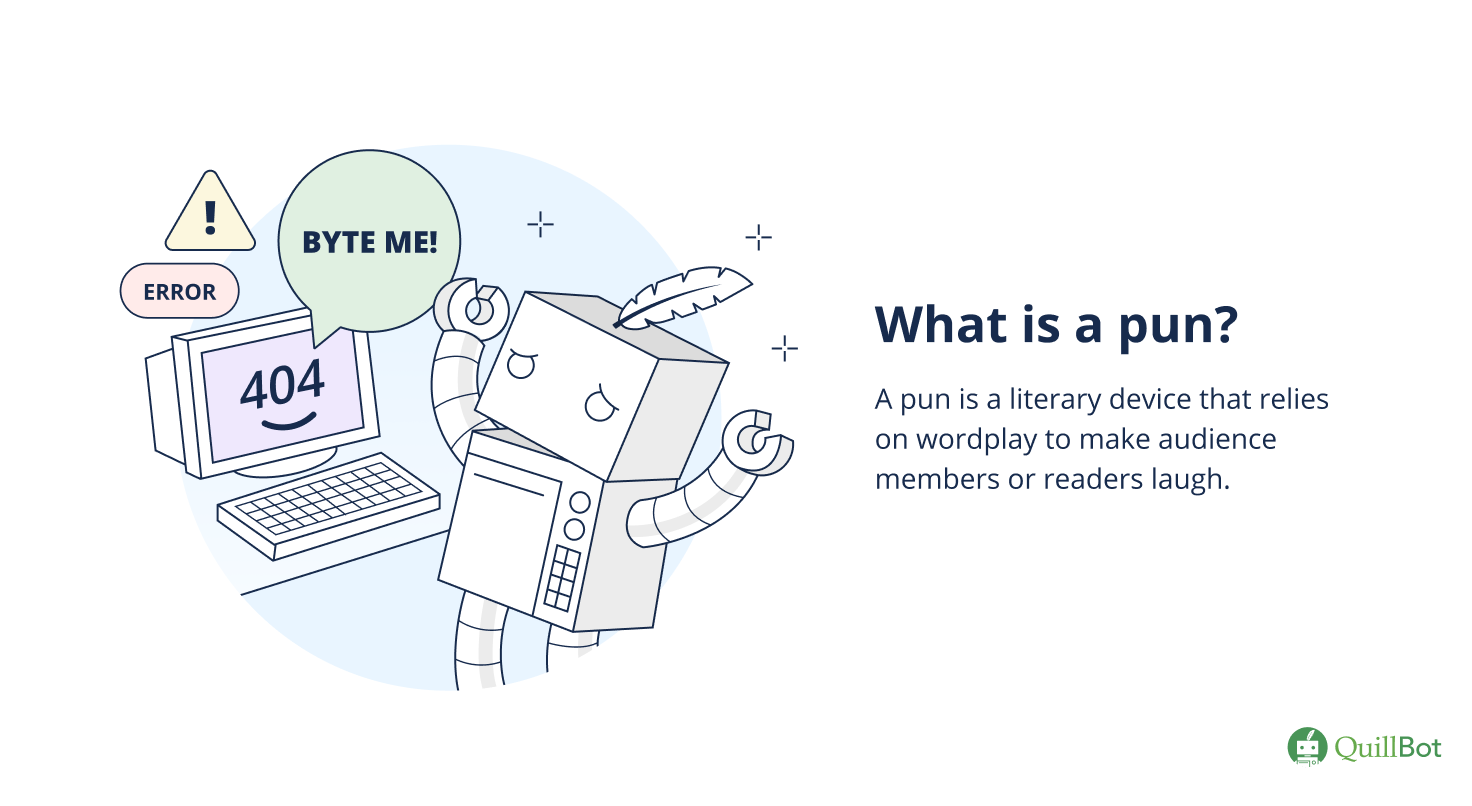
A pun is a literary device that relies on wordplay to make audience members or readers laugh. Puns are typically based on words that sound similar but have different meanings (homonyms), such as “too tired” and “two-tired.”
I used to be a banker, but I lost interest.
I wondered why the ball was getting bigger. Then it hit me!
Puns are a staple of comedy, but you may also encounter them in literary works, like theatrical plays, novels, and poems.
What is a pun?
A pun (also known as paronomasia) is a type of joke that experiments with the different meanings of a word or with words that sound similar. Although puns are generally used in a humorous way, they can also be used to indicate linguistic dexterity (as in riddles) or to create irony.
Puns often make a text more engaging and memorable because they cause the reader or audience to stop momentarily and think about the true meaning of a phrase. However, not everyone agrees that puns are clever or funny. Terms like “dad joke” and “groaner” are sometimes used to negatively refer to jokes or puns that are predictable.
Nevertheless, puns are frequently used in pop culture. For example, they are often used in movie titles (e.g., Bee Movie) and fictional character names (e.g., the lawyer “Bob Loblaw” in Arrested Development).
4 types of puns
There are four main types of puns:
Homophonic pun
A homophonic pun is based on words that are pronounced the same but differ in meaning and spelling (e.g., “ate” and “eight” or “male” and “mail”).
Homographic pun
Homographic puns involve two words that are spelled the same but have different meanings and/or pronunciations, like “object” (thing) and “object” (argue). These puns rely on sight and are therefore mostly used in writing.
In this quote by Douglas Adams, there is a homophonic pun (“tune a”/“tuna”) and a homographic pun involving bass (the guitar, which is pronounced “base”) and bass (the fish).
Homonymic pun
A homonymic pun refers to wordplay that relies on words that are spelled and pronounced the same, but differ in meaning. For example, “ring” can refer to either a circle or to the act of calling someone’s phone.
Compound pun
Compound puns are complex puns that combine two or more homonymic, homographic, or homophonic puns in one statement.
Pun examples
Writers often use puns in literary works to play with a word’s multiple meanings and to add depth to the text.
Made glorious summer by this sun of York;
And all the clouds that lour’d upon our house
In the deep bosom of the ocean buried.”
In the opening lines from William Shakespeare’s Richard III, the titular character gives a speech commenting on the change from war to peace that his brother, King Edward IV brought about. Here the word “sun” is a pun: it refers to Edward’s banner which depicts a sun, and it also alludes to the fact that he is a member (son) of the House of York.
Puns can also be used to highlight or foreshadow themes in a text.
On the one hand, the title emphasizes the quality of being “earnest” or sincere, which is highly valued in the society the play takes place in. On the other hand, as the play progresses, characters adopt the name “Ernest” as a pseudonym or alter-ego, leading to an ironic juxtaposition between the importance of being “earnest” and the characters’ deceitful behavior.
Ultimately, the title encapsulates the main theme of the play, which is social pretense, and serves to satirize the shallowness of the society depicted.
In pop culture, puns are not only used as clever one-liners; they can also take the form of running jokes.
Pun jokes
Pun jokes are a form of humor that relies on wordplay (e.g., similar-sounding words or words with a double meaning).
Never discuss infinity with a mathematician. They can go on about it forever.
It was an emotional wedding. Even the cake was in tiers.
A pessimist’s blood type is always B-negative.
Frequently asked questions about puns
- What is the difference between a double entendre and a pun?
-
Double entendres and puns are both figures of speech that involve ambiguity and double meanings. However, they are not exactly the same.
A double entendre uses a word that seems innocuous at the surface level but also carries a second meaning that would be too inappropriate or sexually suggestive to state directly.
On the other hand, a pun also exploits two possible interpretations of a word, but it is usually in a clever or humorous way, without any suggestive meaning.
In short, a double entendre may use a pun. However, not all puns are considered double entendres.
Cite this QuillBot article
We encourage the use of reliable sources in all types of writing. You can copy and paste the citation or click the "Cite this article" button to automatically add it to our free Citation Generator.
Nikolopoulou, K. (2025, November 27). What Is a Pun? | Definition, Types & Examples. Quillbot. Retrieved April 10, 2026, from https://quill.cosmictools.in/blog/rhetoric/pun/