Published on
July 3, 2024
by
Gina Rancaño, BA.
Revised on
May 7, 2025
Hola (pronounced “oh-laa”) is how to say hi in Spanish.
While “hi” is considered slightly more casual than “hello” in English, in Spanish, “hola” can be used to say “hi” or “hello” and is appropriate in informal and formal contexts.
It’s common to add other phrases when saying “hi” in Spanish. For example, “Hola, mucho gusto” means “Hi, nice to meet you.”
There are a few other ways to say “hi” in Spanish, but keep in mind that some are considered more informal than others.
Published on
June 27, 2024
by
Gina Rancaño, BA.
Revised on
December 2, 2025
There are several ways to say how are you in Spanish, including:
¿Cómo estás? (How are you?)
¿Cómo te va? (How’s it going?)
¿Cómo va todo? (How’s everything going?)
¿Qué tal? (What’s up?)
¿Cómo has estado? (How have you been?)
¿Cómo te ha ido? (How have you been?)
¿Cómo andas? (How are you?)
Cómo estás (pronounced “ko-mo-ehs-taas”) is the simplest and one of the most common ways to say “how are you” in Spanish. Although it is considered more casual than other options, “cómo estás” is widely acceptable in both formal and informal settings (e.g., “Hola, mucho gusto. Soy Dra. López. ¿Cómo estás?”).
TipQuillBot’s Paraphraser can help you write in Spanish with the right tone and style for your audience, whether you’re writing formally or informally. Try it today!
Published on
June 13, 2024
by
Gina Rancaño, BA.
Revised on
December 10, 2025
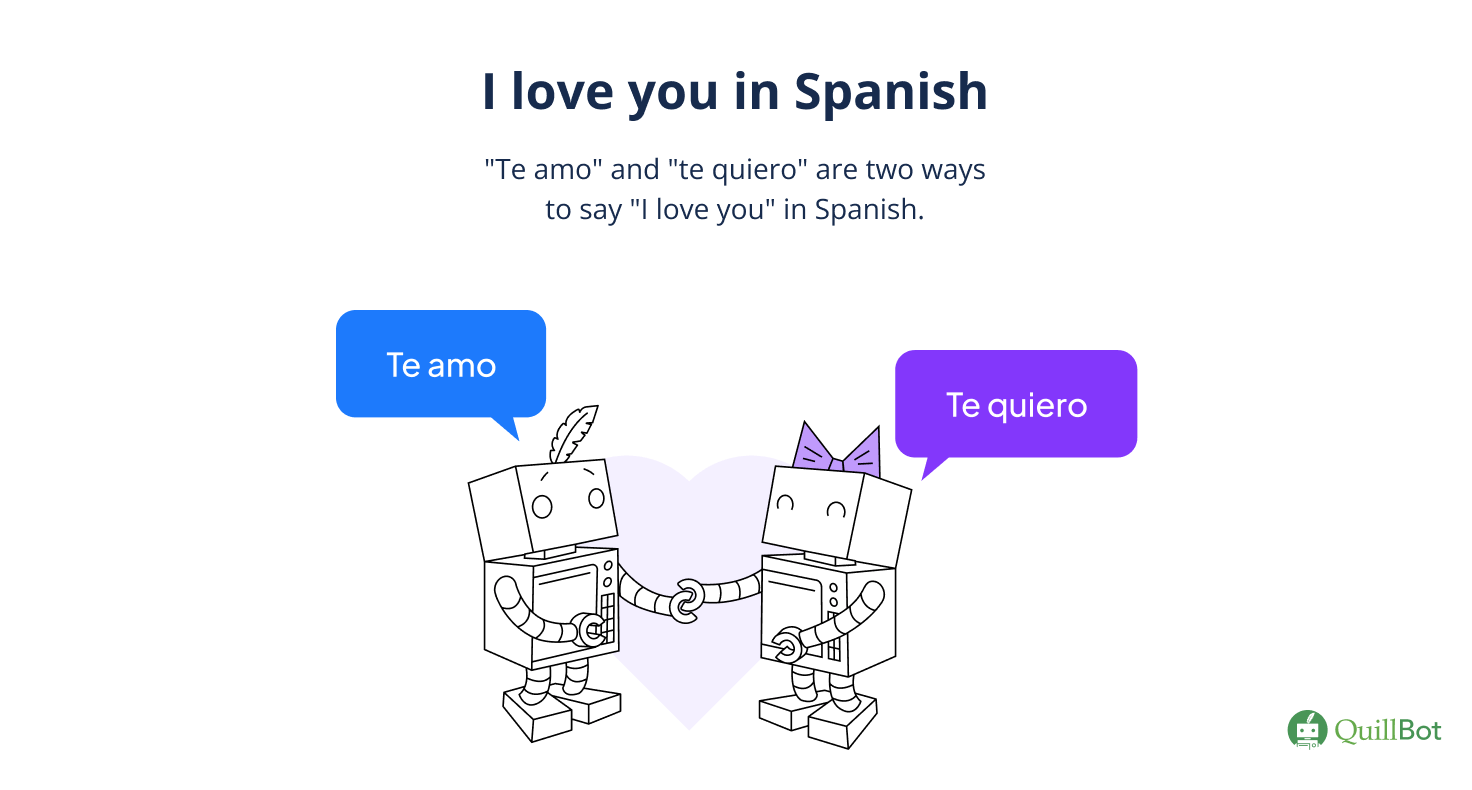
There are several ways to say I love you in Spanish.
Te quiero (I love you)
Te amo (I love you)
Te adoro (I adore you)
Estoy enamorado/a de ti (I’m in love with you)
Me gustas mucho (I like you very much)
Eres el amor de mi vida (You’re the love of my life)
Estoy loco/a por ti (I’m crazy for you)
“Te quiero” (pronounced “teh-kyeh-rro”) is the simplest way to say “I love you” in Spanish. Although it’s more casual than other phrases, it can be used when talking to friends, family, or a romantic partner (e.g., “Te quiero mucho, hermano”).
Additionally, “te quiero” works whether it is being used by a man or a woman. Because Spanish is a gendered language, some of the phrases listed above have to be modified depending on the context (similar to the many ways of saying “nice to meet you” in Spanish).
For example, “estoy enamorado de ti” means “I’m in love with you,” but the phrase can only be used by a man. If a woman were using it, she would have to say, “estoy enamorada de ti.”
QuillBot’s free Grammar Checker can help you write “I love you” in Spanish perfectly by helping you avoid spelling, grammar, and punctuation mistakes.
NoteIn Spanish, some people use the letter “e” in nouns or adjectives as a more inclusive and nonbinary approach to writing. For example, instead of saying “ellos” (referring to a group of only men or a group of men and women) or “ellas” (referring to a group of women), some people use the term “elles” to avoid specifying gender.
However, the gender inclusive use of “e” in place of “o” or “a” is not officially recognized and might lead to mixed reactions, as some people believe that the language should maintain the traditional spelling and grammar conventions that make it unique.
Mucho gusto (pronounced “moo-cho goose-toe” is the simplest way to say “nice to meet you” in Spanish because it’s suitable for formal and informal settings, and the phrase works regardless of who’s speaking and who is being spoken to (e.g., “Mucho gusto, Juan. Mi nombre es Alexandra”).
Because Spanish is a gendered language, many other “nice to meet you” phrases must be modified depending on the speaker and audience. For example, “encantado de conocerlo” works only when a man is communicating with another man. If he were meeting a woman, he would have to say, “encantado de conocerla.” Additionally, some phrases are considered more formal than others.
TipTry QuillBot’s Grammar Checker to avoid spelling, grammar, and punctuation mistakes when writing in Spanish.