Published on
September 25, 2024
by
Gina Rancaño, BA.
Revised on
November 18, 2025
The seasons in Spanish are:
primavera (spring): pronounced “pree-mah-veh-rah”
verano (summer): pronounced “veh-rah-noh”
otoño (autumn): pronounced “oh-toe-nyoh”
invierno (winter): pronounced “een-vee-ehr-no”
It’s important to note that many Spanish-speaking countries, particularly those in the tropics, categorize the seasons into two: “estación seca” (dry season, sometimes also known as “verano”) and “estación lluviosa” (rainy season, sometimes also known as “invierno”).
Additionally, the seasons and the months they occur in can vary significantly across Spanish-speaking countries due to their geographic locations.
In Spanish, the seasons are typically preceded by the definite articles “el” or “la,” depending on which is being referred to. “Verano,” “otoño,” and “invierno” are considered masculine nouns and are therefore accompanied by “el” (e.g., “el verano”). “Primavera” is considered a feminine noun and is therefore accompanied by “la” (e.g., “la primavera”).
Keep in mind that definite articles are not always necessary. The seasons in Spanish can also be preceded by prepositions like “de” or “en” (e.g., “En primavera, las flores florecen”) or by a form of the verb “ser,” which means “to be” (e.g., “Le dije que es primavera todavía, no verano”).
Published on
July 12, 2024
by
Gina Rancaño, BA.
Revised on
August 7, 2025
The months of the year in Spanish are:
enero (January)
febrero (February)
marzo (March)
abril (April)
mayo (May)
junio (June)
julio (July)
agosto (August)
septiembre (September)
octubre (October)
noviembre (November)
diciembre (December)
Similar to the days of the week in Spanish, the months are all considered masculine nouns. Additionally, they don’t have to be capitalized unless at the start of a sentence (e.g., “Me voy de viaje el seis de mayo”).
TipTry QuillBot’s free Grammar Checker if you need some extra reassurance while writing in Spanish!
Published on
July 12, 2024
by
Gina Rancaño, BA.
Revised on
December 2, 2025
There are several different ways to say you’re welcome in Spanish, including
De nada
No es nada
Por nada
Está bien
No hay problema
No te preocupes
Con gusto
A la orden
Es un placer
“De nada” is one of the most commonly used phrases and is suitable for both formal and informal contexts. QuillBot’s Paraphraser can help you refine your writing so you can convey the right tone, even when you’re writing in Spanish.
Published on
July 12, 2024
by
Gina Rancaño, BA.
Revised on
December 2, 2025
There are many ways to say goodbye in Spanish. A few of the most common are:
Adiós
Nos vemos
Hasta luego
Hasta pronto
Hasta la próxima
Cuídate
Chao
Keep in mind that, similarly to saying “hi” in Spanish, some goodbye phrases are more suitable than others, depending on the context. For example, “hasta luego” is considered more formal than “chao,” which is a casual and colloquial expression. To find the right tone, use QuillBot’s free Paraphraser.
Published on
July 5, 2024
by
Gina Rancaño, BA.
Revised on
November 14, 2024
The days of the week in Spanish are:
lunes (Monday)
martes (Tuesday)
miércoles (Wednesday)
jueves (Thursday)
viernes (Friday)
sábado (Saturday)
domingo (Sunday)
Spanish is a gendered language, meaning that all nouns are considered either masculine or feminine, and the days of the week in Spanish are all masculine (e.g., “el martes”).
TipQuillBot’s Grammar Checker can ensure you’re writing the days of the week in Spanish correctly. Try it today!
Published on
July 5, 2024
by
Gina Rancaño, BA.
Revised on
December 2, 2025
Sí (pronounced “see”) is the most common way to say yes in Spanish, as it is a direct translation. But similar to English, there are many other ways to say “yes” in Spanish, including claro, por supuesto, bueno, and cómo no.
TipTry QuillBot’s free Grammar Checker to ensure you write all the different ways of saying “yes” in Spanish correctly, including those with accents (like “cómo no”).
Published on
July 4, 2024
by
Gina Rancaño, BA.
Revised on
December 2, 2025
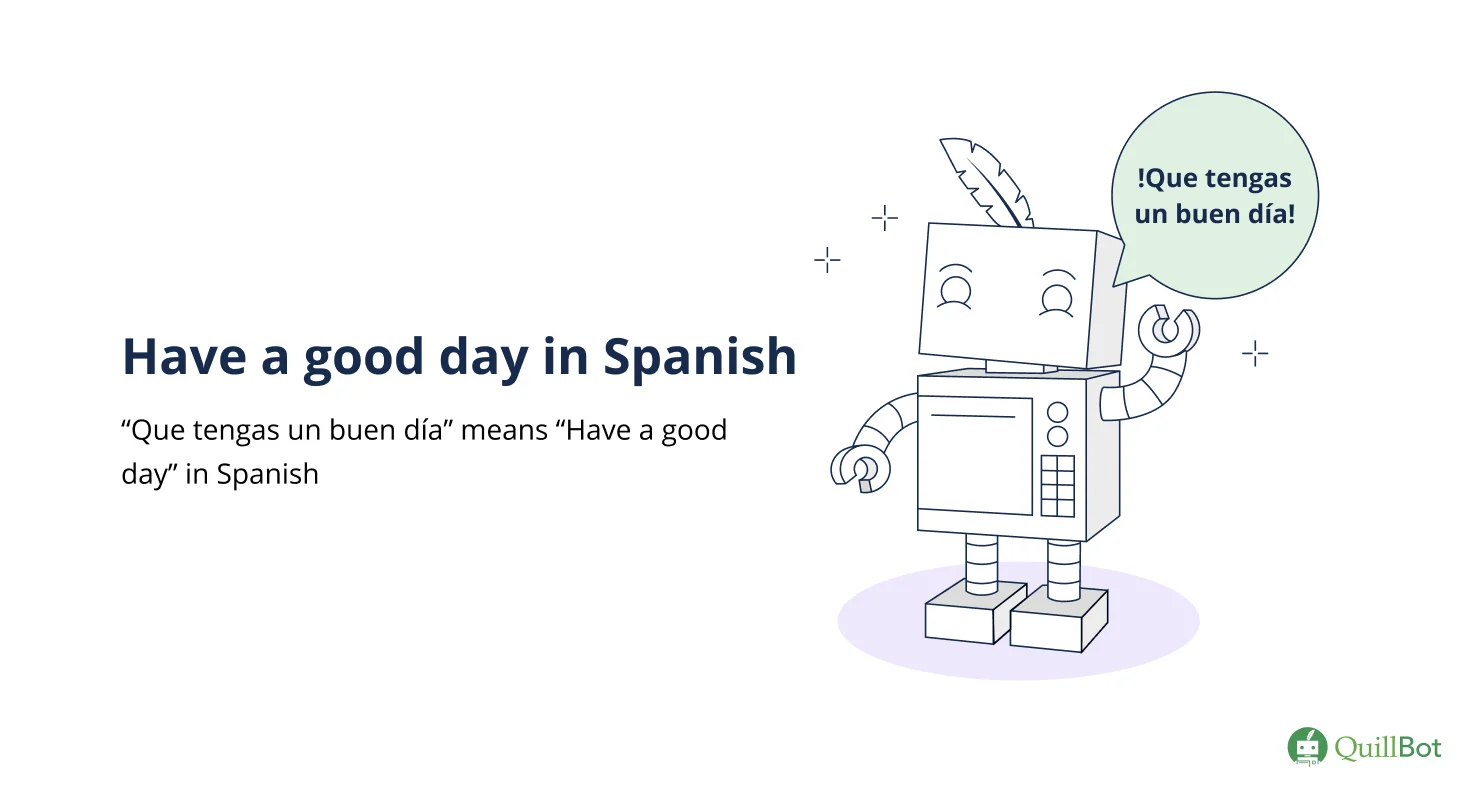
Que tengas un buen día is a common way to say have a good day in Spanish. It’s suitable for most contexts, although it is considered a casual and informal expression. The formal version, “que tenga un buen día,” is used when speaking to someone older than you or with whom you want to show respect.
TipQuillBot’s Paraphraser can help you get your tone just right, whether you’re writing in Spanish formally or informally. Try it today!
There are many other ways to say “have a good day” in Spanish. Keep in mind that they must be slightly altered depending on the context and recipient of the phrase. For example, if you’re speaking to a group of people, the correct version of the phrase above is “que tengan un buen día.”
How to say have a good day in Spanish
Phrase
Example
Que tengas un buen día
(Informal)
¡Gracias por tu ayuda, Amanda! Que tengas un buen día.